

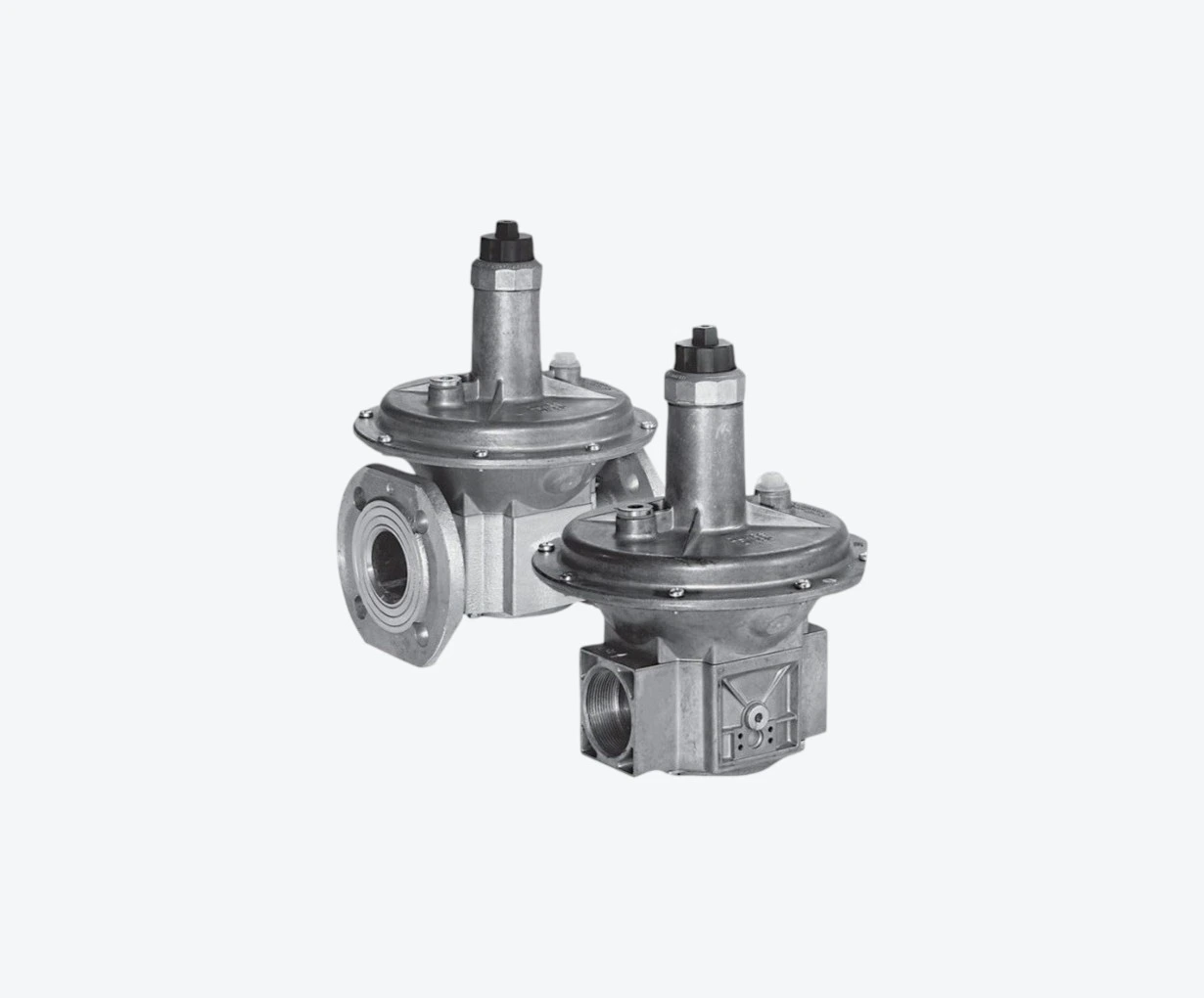

In industrial combustion systems, the natural gas pressure regulator is the gatekeeper of the gas train. While burners receive the spotlight for efficiency and emissions control, their performance is entirely dependent on the stability of the fuel delivery system.
Whether upstream of a 1.5 MW gas turbine or an industrial steam boiler, selecting the wrong regulator can lead to burner instability, flame-outs, dangerous pressure spikes, or fuel starvation. Choosing the correct natural gas regulator requires a deep understanding of fluid dynamics, system flow mechanics, and safety architectures.
1. The Core Parameters of Regulator Sizing
Regulator selection must never be based solely on pipe size. Matching a regulator to the existing pipe diameter is a frequent design error that leads to chronic operational issues. Instead, sizing must be dictated by five fundamental thermodynamic and physical variables:
- Inlet Pressure Range (Pin): Utility supply pressures fluctuate based on grid demand, seasonal changes, and upstream piping constraints. You must identify both the maximum potential inlet pressure (to ensure structural safety and avoid overpressure) and the minimum potential inlet pressure (to ensure the regulator can still deliver the required flow).
- Outlet Pressure (Pout): This is the precise setpoint required by the burner manifold or gas valve train. The regulator must maintain this pressure within tight tolerances regardless of inlet pressure shifts.
- Volumetric Flow Rate (Q): Sizing requires knowing the maximum gas consumption of the combustion equipment (typically measured in m3/h or CFH). Crucially, the minimum flow rate must also be calculated to prevent the regulator from “hunting” or cycling at low burner firing rates.
- Gas Specific Gravity: While standard natural gas has a specific gravity of roughly 0.60, variations in composition or alternative fuels (such as LPG or hydrogen blends) alter the density and flow characteristics, requiring correction factors during sizing equations.
- Operating Temperature: Extreme ambient or gas temperatures affect elastomer flexibility, seat sealing capabilities, and gas density.
2. Direct-Acting vs. Pilot-Operated Regulators
Industrial natural gas regulators fall into two primary architectural categories. Choosing between them depends on your capacity requirements and the accuracy class (AC) demanded by the downstream equipment.
Direct-Acting (Spring-Loaded) Regulators
Direct-acting regulators utilize a mechanical spring to counteract the downstream gas pressure acting on a diaphragm. When downstream pressure drops, the spring forces the valve plug open.
- Advantages: Extremely fast response times to sudden changes in flow demand, simple mechanical design, low maintenance, and highly reliable.
- Disadvantages: Subject to “droop” (a progressive drop in outlet pressure as the flow rate increases). They are best suited for lower flow capacities or applications where slight pressure variances are acceptable.
Pilot-Operated Regulators
Pilot-operated units use a secondary, smaller regulator (the pilot) to amplify pressure changes and control the loading pressure across a main modulating diaphragm or sleeve.
- Advantages: Virtually eliminates droop, providing a flat pressure control curve across 100% of the flow range. Capable of handling massive volumetric flow rates and high pressure differentials.
- Disadvantages: Slower response time compared to direct-acting models; more sensitive to particulates or wet gas in the fuel line.
Architectural Comparison for Gas Trains
| Selection Metric | Direct-Acting (Spring-Loaded) | Pilot-Operated |
| Pressure Control Accuracy | Moderate (typically +-10% to +-20% accuracy) | High (typically +-1% to +-5% accuracy) |
| Response to Burner Modulation | Instantaneous (Excellent for rapid-cycling burners) | Delayed (Requires careful tuning for high-turndown burners) |
| Minimum Differential Pressure | Requires very low differential pressure to operate | Requires a minimum pressure drop to stroke the valve |
| Capacity Capability | Low to Medium | High to Ultra-High |
3. Critical Performance Dynamics: Droop and Lock-Up
To select a regulator that preserves burner efficiency, engineers must evaluate two distinct performance characteristics found on manufacturer flow curves:
Droop (Offset)
As the burner modulates from low fire to high fire, the regulator valve must open wider. In a direct-acting regulator, as the control spring extends, it loses some of its force, causing the downstream setpoint pressure to decrease. This drop is called droop. Excess droop starves the burner of fuel at peak loads, altering the fuel-air ratio and causing dropping efficiency or high CO emissions.
Lock-Up Pressure
When the burner cuts off instantly (e.g., during a safety shutdown), the regulator must close completely to stop the flow of gas. The pressure increase required to force the regulator plug to seal tightly against its seat is known as the lock-up pressure.
Engineering Note: A high quality B2B industrial regulator should feature a low lock-up pressure zone (typically within 10% to 20% of the setpoint). If the lock-up pressure is too high, the gas train pressure will creep upward during shutdown periods, potentially tripping downstream high-pressure switches or damaging delicate burner control valves.
4. Safety Architecture: Overpressure Protection
Natural gas is inherently volatile; therefore, regulator selection is fundamentally tied to system safety mitigation. If a regulator diaphragm ruptures or a weld-slag particle scores the valve seat, full upstream inlet pressure can surge downstream. Two primary mechanisms prevent this catastrophic failure:
- Slam-Shut Valves (SSV): A slam-shut valve is a completely independent safety device integrated into or installed immediately upstream of the regulator. It monitors downstream pressure mechanically. If pressure exceeds a pre-set threshold, a spring-loaded internal mechanism slams the valve closed. It remains locked out until an operator manually resets it after troubleshooting. This is the preferred method for high-pressure industrial facilities as it vents zero gas to the atmosphere.
- Safety Relief Valves (SRV / Token Relief): Relief valves open at a set pressure to vent excess gas capacity safely out of a exhaust stack to the atmosphere. While effective for low-pressure commercial systems or smaller loads, venting massive volumes of industrial-grade natural gas creates immediate environmental and ignition hazards, making SSV systems the superior choice for major industrial gas trains.
Conclusion: Ensuring Combustion Stability
A properly selected natural gas pressure regulator acts as a stabilizing shock absorber for your thermal processing equipment. By evaluating the full envelope of minimum and maximum inlet pressures, focusing on minimizing droop across your burner’s complete turndown range, and integrating a robust slam-shut safety architecture, you ensure consistent fuel-air ratios. This attention to upstream engineering safeguards mechanical equipment, maintains emissions compliance, and delivers the steady thermal output required by high-performance industrial operations.